

Hungary said it will launch a legal challenge against the European Union's approval of a provisional agreement on phasing out imports of Russian natural gas as the bloc looks to end its dependency on Russian energy.
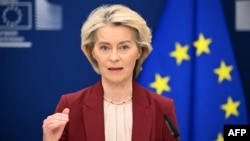
European Commission President Ursula von der Leyen said the bloc was entering a "new era" by phasing out Russian fossil fuels, which includes a measure adopted on December 3 to prohibit liquefied natural gas (LNG) imports by the end of 2026, with pipeline natural gas imports to be phased out by autumn 2027.
"This is the dawn of a new era: the era of Europe's full energy independence from Russia," she said in a statement on December 3.
"As we slashed Russian imports of fossil fuels massively we also cut the revenues that Russia uses to wage its war of aggression against Ukraine, we were paying to Russia 12 billion euros ($14 billion) per month at the beginning of the war for fossil fuels now we are down to 1.5 billion euros per month. Still too much. We aim to bring it down to zero," she added.

The regulation is legally binding, prompting landlocked Hungary, which is highly dependent on Russian supplies, to say it will challenge the decision at the EU's Court of Justice.
"Accepting and implementing this Brussels order is impossible for Hungary," Foreign Minister Peter Szijjarto said during a briefing broadcast on his Facebook page.
"As soon as the RePowerEU plan is formally adopted, we will immediately challenge it before the Court of Justice of the European Union," he added in a post on X.
Szijjarto added that the decision violates the bloc's founding document and called it a sanctions measure against Russia and not a real trade policy move.
Hungarian Prime Minister Viktor Orban, who has often criticized Europe for taking what he called a "hard-line" stance on Russia over its war against Ukraine, has said Russian energy is "vital" for Hungary.
Slovakia, which has also complained of the impact that turning away from Russian supplies would have on its economy, said it is weighing a response to the adoption of the new measures.
The EU's REPowerEU strategy to end dependency on Russian energy came about as a result of the Kremlin's full-scale invasion of Ukraine in February 2022.
Brussels wants to stop Moscow's use of gas supplies as a geopolitical weapon as well as cutting off funds Russia badly needs to finance its war.
US President Donald Trump has also chided Europe for its dependence on Russian energy.
The US Treasury Department announced on October 22 that it was sanctioning state-controlled Rosneft and privately owned LUKoil -- Russia’s two largest oil companies, whose exports go a long way toward filling the Kremlin's coffers.
A day later, Brussels targeted Rosneft and Gazpromneft, another major oil company that is a subsidiary of state-controlled gas giant Gazprom.
Trump, however, also gave Hungary an exemption from US sanctions on Russian energy purchases, according to Orban, one of the US president's closest allies in Europe.
"We've made it: Europe is turning off the tap on Russian gas, forever," EU Energy Commissioner Dan Jorgensen wrote on X. "We've chosen energy security and independence for Europe. No more blackmail. No more market manipulation by Putin. We stand strong with Ukraine."
The Kremlin said the move would "accelerate" the decline of the European economy's leading potential and "reduce its competitiveness."
"This means Europe will depend on gas that is more expensive and sometimes significantly more expensive than Russian gas," Kremlin spokesman Dmitry Peskov told reporters.
In order to be formally adopted, the provisional agreement must be endorsed by the European Parliament and member states.