




Vladyslav Dolynniy and his team were inside a medical center in Bilenke, a village on the Ukrainian-held right bank of the Dnieper River south of Zaporizhzhya, when they heard an explosion.
Once outside, they found that a clearly marked ambulance parked nearby had been hit by a drone, its rear window shattered and the interior damaged.
Nobody was hurt, but it was an unwelcome milestone.
The first time an ambulance in the Zaporizhzhya region had been hit by a first-person view (FPV) drone, according to Dolynniy, head of the operational dispatch department at the regional Center for Emergency Medical Care and Disaster Medicine.
The first time in Zaporizhzhya, but not nationwide.
Medical vehicles and personnel have been hit in several other frontline regions, from Sumy in the northeast to Kherson in the south, where authorities say they have been hit many times since an ambulance was struck on February 26, 2022, two days after Russia launched the full-scale invasion.
And it’s getting worse.
As Russia deploys more advanced, harder-to-detect drones, frontline medical teams are increasingly finding themselves in danger. Ambulances and emergency crews – protected under international law -- are now being targeted on the battlefield by the Russian military, according to Ukrainian soldiers and medical personnel.
Medical personnel operating near the front line say that even specially equipped ambulances can no longer guarantee protection.
“We have a car that goes to frontline villages, and it is fitted out with [jamming equipment] and a warning system that detects FPV drone frequencies. But today this is not a guarantee of safety, because fiber-optic drones do not give off a signal, and [jamming equipment] does not work against them,” Dolynniy told RFE/RL’s Ukrainian Service.
“When drones appeared that operate not on radio frequencies but on fiber optics, there was absolutely no protection from them. First of all, you can’t locate them,” Dolynniy said.
Another problem, he added: “Evacuations are occurring farther from combat zones.”
'Much More Difficult'
Ukrainian military analyst Serhiy Hrabskiy explained that the growing use of longer-range weapons, including fiber-optic-guided drones capable of striking from up to 50 kilometers away, are forcing medics to take wounded soldiers further from the front, leaving the rescuers and the rescued in danger for substantially longer periods of time.
“It’s one thing if you remain in a threatening zone for 10 minutes, and a completely different thing if it takes half an hour. It makes the work of medical teams much more difficult,” Hrabskiy said.
He also said that the rapid evolution of drones creates challenges for detection systems: “You can adjust your detection devices to one set of frequencies -- but what happens when the drone starts using another spectrum? You must constantly reprogram your systems to intercept them and understand what frequencies they operate on.”
In August 2024, the World Health Organization said it had confirmed 1,940 attacks on health-care facilities, vehicles, and workers in Ukraine since the start of the full-scale invasion -- the highest number it has ever documented in any humanitarian emergency.

According to Ukraine’s Health Ministry, at least 443 emergency medical vehicles have been destroyed or damaged since the start of the full-scale invasion, and at least 815 health-care facilities have been damaged or destroyed across the country.
“Medical transport has now become one of the priority targets for operators of Russian strike drones,” Oleksiy, a senior paramedic with the 154th Motorized Rifle Brigade’s evacuation unit who gave only his first name, told RFE/RL’s Donbas.Realities.
“Previously, during past wars, no one touched the red cross. Doctors marked themselves with red crosses, and they were not targeted,” he said. “The current war has no human face - the Russians are actively destroying the red cross.”
Under the Geneva Conventions , "mobile medical units, as well as transports of wounded and sick or of medical equipment, may under no circumstances be attacked, and shall at all times be respected and protected by the parties to the conflict."
The Health Ministry says the greatest damage to medical infrastructure has occurred in Donetsk, Kharkiv, Dnipropetrovsk, Kherson, Zaporizhzhia, and Luhansk regions – all along the front in the biggest war in Europe since 1945.
One of the regions most frequently targeted is Kherson, where Russian forces menace Ukrainian soldiers and civilians from occupied territory across the Dnieper. On November 17, in one of two attacks on medics in Kherson, a 64-year-old ambulance driver received shrapnel wounds and a 32-year-old paramedic suffered a concussion and head wound.
'It Must Be Recorded'
Russia claims it does not target civilian facilities despite ever-growing evidence to the contrary -- including numerous deadly strikes on hospitals, some of them far from the front.
In July 2024, two people were killed at Ukraine’s largest children’s hospital, Okhmatdyt in Kyiv, in part of a wave of strikes that killed at least 43 people in a single day.
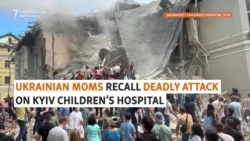

In November 2022, a missile strike on a maternity ward in Vilnyansk, in the Zaporizhzhya region, killed a newborn baby and injured the infant’s mother and a doctor.
Documenting attacks on medical personnel, vehicles, and facilities is a vital part of future national and international accountability efforts, said Dmytro Hladkiy, a Ukrainian lawyer who has been recording such incidents in Zaporizhzhya since 2022.
"It must be recorded so that years later no one can say that ‘nothing happened’ or that ‘there is not enough evidence,’” Hladkiy told RFE/RL’s Ukrainian Service.
In total, Ukrainian and international investigators have opened more than 150,000 cases on alleged Russian war crimes and atrocities, a number that continues to rise as new attacks are recorded.