



China has rattled Tehran by again backing the United Arab Emirates’s claim over three Persian Gulf islands controlled by Iran.
Following a visit to Abu Dhabi by Chinese Foreign Minister Wang Yi, the countries in a joint statement on December 13 highlighted Beijing’s “support for the efforts of the UAE to reach a peaceful solution to the dispute” over the three islands of Greater Tunb, Lesser Tunb, and Abu Musa. Notably, there is no explicit mention of Iran in the statement.
In response, Iranian Foreign Ministry spokesman Esmail Baqaei criticized the UAE’s “insistence on misusing every diplomatic delegation’s visit” to raise claims about the three islands.
The Taiwan Card
While Baqaei didn't criticize China, Iranian media have been more explicit in their assessment of Beijing's statement.
Keyhan, a hard-line newspaper whose chief editor is appointed by the supreme leader, argued that China’s support for the UAE’s claim meant that it “has implicitly accepted that its own claim over Taiwan is disputable and should be resolved through negotiations.”
Ahmad Naderi, a member of the presiding board of Iran’s conservative-leaning parliament, echoed a similar sentiment, accusing Beijing of adopting a “double standard” and saying it cannot insist on its One China policy while simultaneously questioning Iran’s territorial integrity.
In an implicit reference to Taiwan, the state-affiliated Mehr news agency said China itself considers “any mention of its territorial integrity a violation of its security red line.”
Therefore, it argued, China’s support for a statement questioning Iran’s sovereignty of the islands “is unjustifiable and cannot be ignored.”
The Islands
The controversy comes against the backdrop of a decades-old sovereignty dispute that has long tested Iran’s relations with its Gulf neighbors.
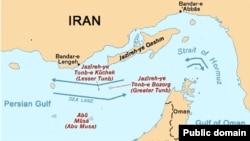
The three islands lie near the mouth of the Strait of Hormuz, a strategic chokepoint through which about one-fifth of the world’s seaborne oil passes.
Iran seized control of the islands on November 30, 1971 -- one day before the British withdrawal from the Gulf and the formation of the United Arab Emirates -- asserting historical claims that date back to the Persian Empire.


Declassified British files released in 2022 show London had agreed to transfer the Greater and Lesser Tunbs to Iran while establishing joint Iranian–Emirati administration over Abu Musa. The dispute reignited in the early 1990s when Tehran tightened its control and expanded its military footprint on Abu Musa.
Despite repeated calls from Gulf Arab states for arbitration or adjudication, Iran has consistently rejected the International Court of Justice’s jurisdiction, insisting that the islands are an inalienable part of its territory and not open to negotiation.
Iran’s strategic partners China and Russia have backed calls by Gulf Arab states on Iran to resolve the issue. Iran last year summoned both Chinese and Russian envoys separately to protest.
Centrist newspaper Jomhuri-ye Eslami, which is generally critical of closer ties with Beijing and especially Moscow, particularly targeted Iran's governments -- and the Foreign Ministry above all -- for "serious inertia and inefficiency.”
Iranian website Asia News said China’s attitude toward the islands has “raised serious doubts” over Tehran-Beijing relations despite a much-touted 25-year strategic partnership agreement.
“Beijing, in its pursuit of energy security and an expanded footprint in the Middle East, appears -- after weighing the costs and benefits -- to have placed greater emphasis on its relations with Arab countries,” it argued.