

Interactive

Russia Aiming To Paralyze Ukraine's Railways

Russian missiles and drones are hitting Ukraine's railway infrastructure and trains more often than ever before as Moscow tries to cripple the country’s logistics.

Ivan Gutterman and Wojtek Grojec
December 15, 2025

Ukraine’s railway network has been crucial in evacuating civilians, moving troops and weaponry, transporting goods for export, and bringing world leaders to Kyiv since Russia launched its full-scale invasion in February 2022.

British Prime Minister Keir Starmer (L), French President Emmanuel Macron (C) and German Chancellor Friedrich Merz (R) pose on board a train to Kyiv, in Shegyni, Ukraine, on May 9, 2025.
Stefan Rousseau / AFP

Early in the war, Russia mostly hit the railway network via artillery strikes not far from where combat was taking place — although there were exceptions.

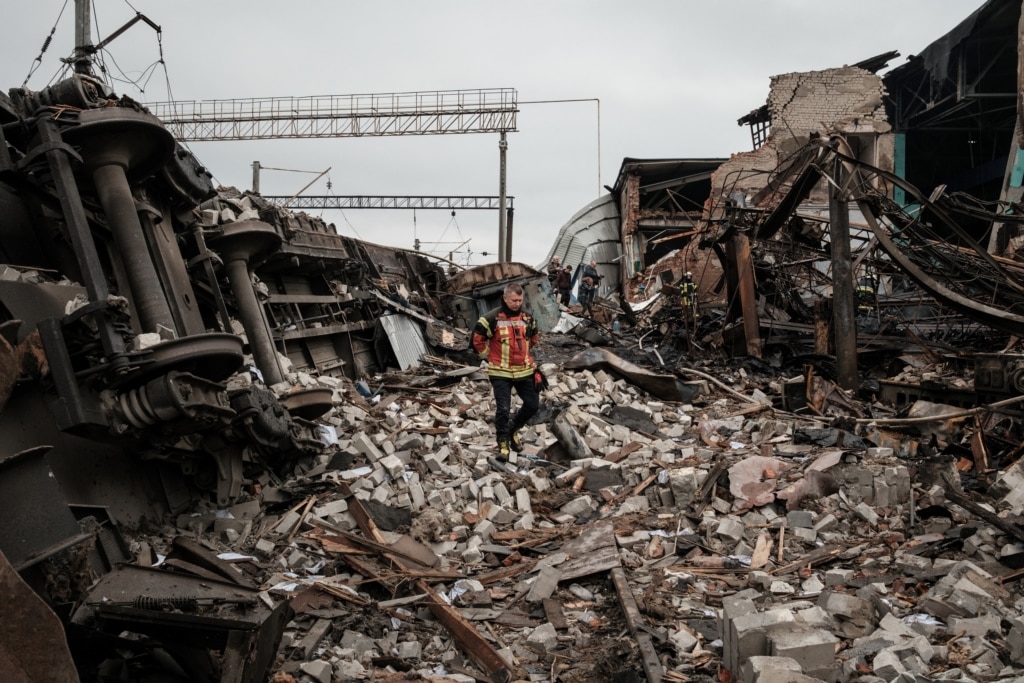
A firefighter walks through rubble at a freight railway station in Kharkiv, which was partially destroyed by a Russian strike.
Yasuyoshi Chiba / AFP

As Russia’s offensive faltered in 2022 and its forces withdrew from around Kyiv and other regions, it sharply reduced strikes on railways for much of 2023 and 2024 — focusing instead on Ukraine’s energy infrastructure.

The strikes picked up in the spring of 2025 — RFE/RL counted more than 100 over the eight months since May. That’s more than double the total for 2023 and 2024 combined.

Six weeks into the invasion, Russia hit the train station in Kramatorsk, Donetsk region, with two Tochka-U ballistic missiles. Thousands of civilians were awaiting evacuation at the station, and 61 people, including seven children, were killed.

Other early strikes on railway stations targeted Ukrainian forces or military equipment concentrated there. Map legend Russia’s Defense Ministry claimed that a strike on May 6, 2022, hit a stockpile of Western-supplied arms at the station in Bohodukhiv, Kharkiv region.

Ukrainian railway infrastructure in the country’s east, now the main focus of Russia’s invasion, has suffered the most — but junction stations in the west have also been targeted, causing delays throughout the network.

“When a train is knocked off its schedule due to damage, this produces a domino effect on other train routes,” says former Deputy Infrastructure Minister Oleksandr Kava.

A drone strike in August hit the station in Koziatyn, destroying rolling stock and forcing trains to change route. 

“Russia’s intention is obvious: to paralyze Ukrainian logistics, because a significant share of cargo — including military cargo — relies specifically on rail connections,” former Ukrainian Minister of Infrastructure Volodymyr Omelyan told RFE/RL’s Rostyslav Khotyn.

Shahed-type drones are doing much of the heavy lifting in Russia’s new campaign, rather than artillery and ballistic missiles. In one of many strikes on the Dnipropetrovsk region, the long-range drones struck a train on July 18, killing the driver and wounding his assistant.

One person was killed and dozens were injured when Russian drones struck passenger trains in Shostka, Sumy region, on October 4.

Ukrainian President Volodymyr Zelenskyy condemned the attack as “terrorism” and Foreign Minister Andriy Sybiha called the campaign “one of the most brutal Russian tactics.”

Moscow has consistently claimed it does not target civilians or civilian infrastructure, despite mounting evidence to the contrary.

Sumy region is close enough to Russia that even small, short-range first-person view (FPV) drones are used to strike its railways, as witnessed by an October 18 strike that damaged a station and injured civilians.

The state railway company, Ukrzaliznytsia, was forced in November to suspend services to Slovyansk in Donetsk region, as well as Kramatorsk — the station where dozens were killed early in the war. Russian forces are now just 20 kilometers away.

Russia’s bombing campaign against Ukraine’s railways shows no signs of letting up. On December 6, a swarm of Shahed drones targeted the station at Fastiv, southwest of Kyiv, damaging it beyond repair.

Besides the junction station at Fastiv, the Vyshhorod and Bucha districts on the outskirts of Kyiv were hit in what a Ukrainian official called Russia’s largest attack so far against railway infrastructure in and around the capital.

The CEO of Ukraine’s state railway company, Oleksandr Pertsovskyi, said that strikes on stations in places like Shostka do not pursue military aims.

“They are doing everything to make frontline and border areas uninhabitable, so that people are afraid to go there, afraid to board trains, afraid to gather at markets, and so that students are afraid to return home.”

Despite the Russian strikes, Ukrzaliznytsia “shows an astonishing capacity for survival,” Omelyan, the former infrastructure minister, says. “Thanks to this, the Ukrainian economy is still functioning.”

Data on strikes was collected from Armed Conflict Location and Event Data (ACLED), and then filtered down to attacks where a note indicates that Ukrainian railway stations, trains, and other related infrastructure suffered damage or were targeted. Ukrainian officials have given higher assessments of the number of strikes on railway infrastructure than this data reflects.