

Iran's first Shanghai Cooperation Organization (SCO) counterterrorism drill is less about joint military strength and more about sending a signal: Tehran wants the world to see it as strategically relevant, even if the exercise itself demonstrates little real multilateral capability.
The five-day "Sahand 2025" drill under the SCO's Regional Anti-Terrorist Structure (RATS) began on December 1 at the Islamic Revolutionary Guards Corps' (IRGC) Imam Zaman Mechanized Brigade base in Shabestar County, East Azerbaijan Province, near Iran's northwestern borders.
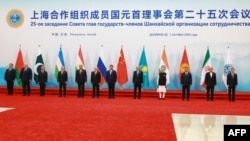
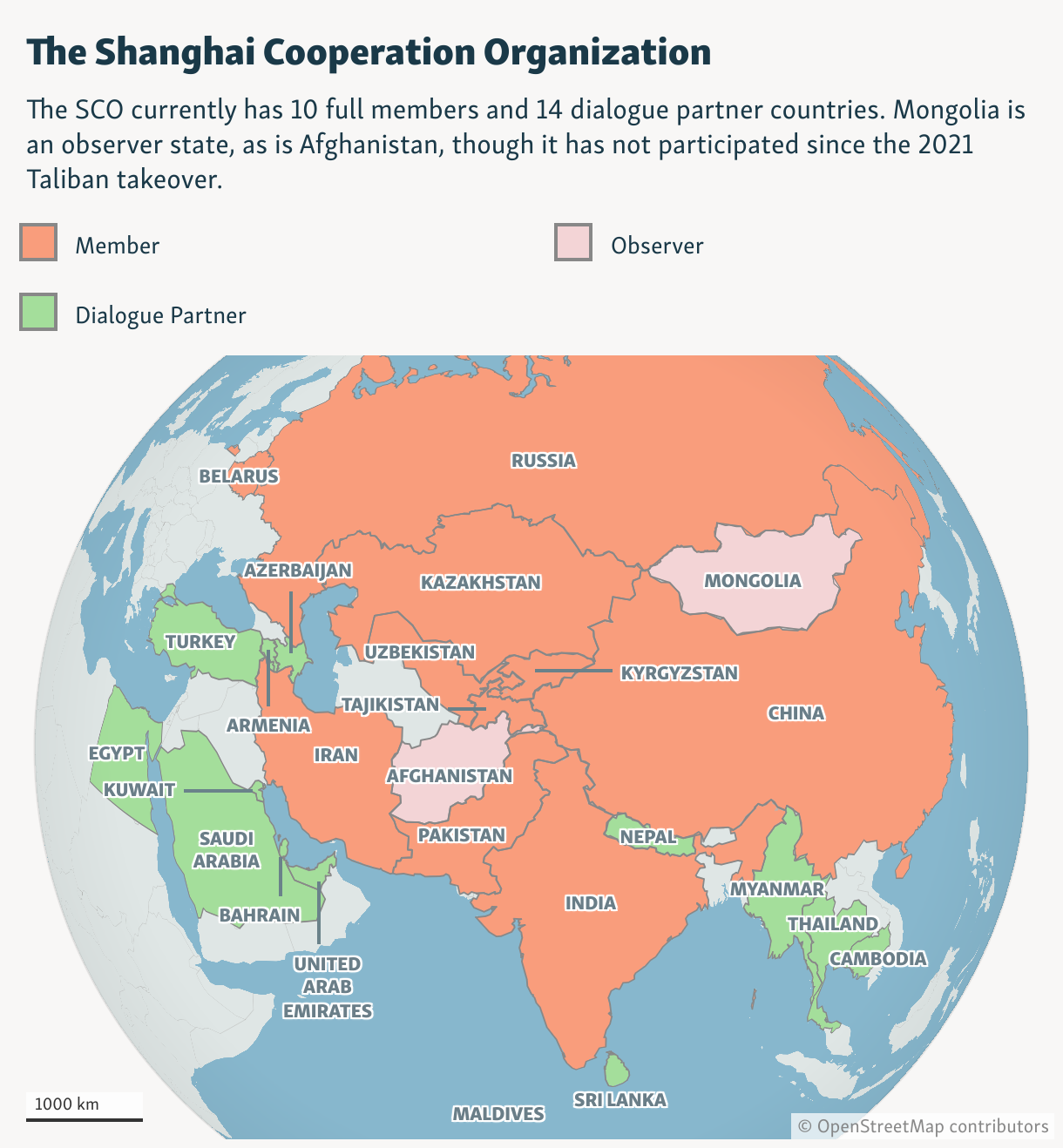
According to the IRGC, the exercises include participation from SCO members -- Belarus, China, India, Kazakhstan, Kyrgyzstan, Pakistan, Russia, Tajikistan, and Uzbekistan -- and observer states and focus on joint operations against terrorism, separatism, and extremism -- the core pillars of RATS' mandate.
But analysts say the exercise's military significance is limited. It is small in scale, lightly attended, and unlikely to meaningfully advance joint operational capability.
Politically, Iran is hoping to leverage the SCO to project alignment with major Eurasian powers and counter the perception of isolation, even if the organization remains fragmented and uncertain about its strategic role. Whether that will succeed is another question.
"An anti-terrorism exercise does not indicate that Iran's relationship with countries like Russia and China is leveling up," Farzin Nadimi, a senior fellow at The Washington Institute, told RFE/RL's Radio Farda, highlighting the symbolic rather than transformative nature of the drills.
Nadimi argued that SCO members are unlikely to have a strong presence in the drills.
"They're probably there just to observe and the heavy lifting will be done by the [IRGC's] mechanized brigade," he said, noting the absence of reporting on member states transporting military hardware to Iran.
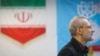
Iran's parliament speaker and former IRGC air force commander Mohammad Baqer Qalibaf framed the drill as a geopolitical message to Western capitals.
"Independent countries are firmly determined to defend themselves against an unjust global order," he declared in a December 2 speech.
But Nadimi said Tehran is overstating the drill's strategic importance.
"This is likely a message to… Azerbaijan and Iraqi Kurdistan, as well as Iranian Kurdish groups based in Iraq," he said. "I don't think an exercise at this level and quality can have any other goals, such as serving as a deterrent against Israel."
Northwestern Iran remains one of the country's most sensitive security zones, home to long-standing separatist sentiment among ethnic Azeris and Kurds. The region has seen activity from Kurdish groups Tehran labels terrorist organizations and serves as a corridor for smuggling networks operating across borders with Armenia as well s Azerbaijan and its Naxcivan exclave.
Tehran's SCO membership -- formalized in 2023 after nearly two decades as an observer -- gives Iran access to expanded intelligence-sharing and the ability to seek formal terrorist designations through RATS. At home, officials have highlighted SCO membership as a diplomatic break from Western isolation.
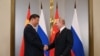
But the organization itself is struggling to define its purpose.
Analysts widely argue that the SCO faces an identity crisis: its mission has blurred over time, mixing counterterrorism cooperation with trade, cultural programs, and broad geopolitical messaging against Western influence.
Internal divisions further complicate matters. Russia increasingly views the SCO as an anti-Western bloc reinforcing its influence in Central Asia, while China prioritizes counterterrorism coordination and advancing its global governance vision. Geographic expansion -- admitting India and Pakistan in 2017, Iran in 2023, and Belarus in 2024 -- has widened the group's reach but also deepened its internal contradictions.